Human-in-the-loop AI automation: design the handoff, not just the agent
A practical framework for escalation thresholds, review interfaces, accountability, and feedback loops in high-impact workflows.
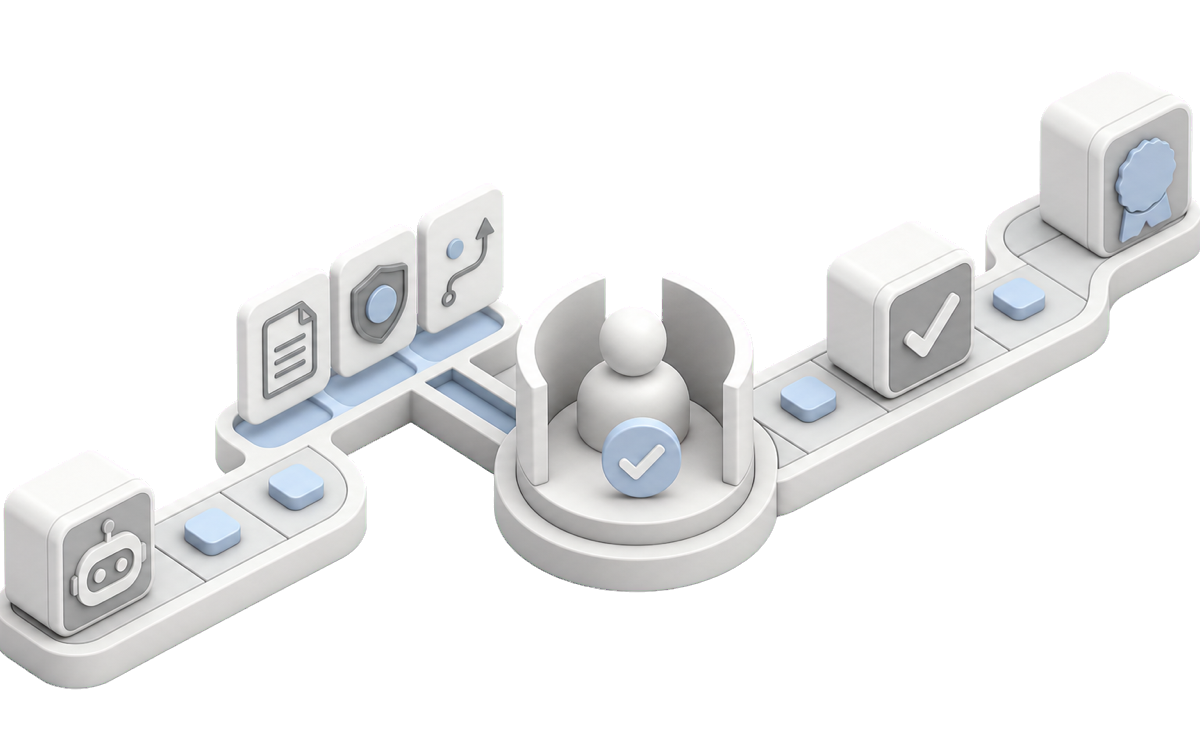
Search for human in the loop AI automation and you will find plenty of feature lists. The harder question is how the system should behave when data is late, a rule changes, or a real person needs to take over. This guide is written for operations and technology leaders deploying AI automation.
The problem behind the feature request
Human review is added as a vague safety valve, creating queues with too little context and no clear decision owner.
The tempting response is to add another screen or automate the visible step. That usually moves the bottleneck rather than removing it. A durable solution starts with the decision, the source of truth, the accountable owner, and the failure path, not with a list of technologies.
A practical approach
We reduce the work to three moves that can be tested in production and understood by the team that will run it:
1. Define escalation by impact, uncertainty, and reversibility
Start here before selecting tools or estimating a full roadmap. For operations and technology leaders deploying AI automation, this establishes the operating boundary and the evidence the team will use to make tradeoffs.
2. Present evidence and a recommended action in the review surface
Turn this into a production workflow with explicit owners, observable failure states, and a small release that tests the hardest assumption early.
3. Capture reviewer changes as structured evaluation feedback
Make the result repeatable: instrument it, document the decision path, and review exceptions with the people who will own the system after launch.
Each move should have a measurable acceptance condition. If the team cannot observe whether the workflow is faster, safer, or more accurate, the release is not yet designed well enough to learn from.
What good looks like
People intervene where judgment matters and automation improves from each reviewed exception.
That outcome is more valuable than a polished demo because it survives normal operational pressure. It gives product, engineering, and operations one shared definition of success, and a clear place to improve next.
Build the smallest production path that proves the hardest assumption.
If this is the problem your team is working through, Vettel Tech can frame the first production slice, identify the operational constraints, and build it alongside the people who will own it.